Monday, March 31, 2014

Schwetzingen Palace Gardens

We reached the castle (around an hour's drive from Heidelberg) around 5 in the evening. We were told that the evening tickets are for minimal prices but would just let you in the garden, not the castle. We later found out that the interiors are not the highlight of the place at all. Moreover, the gardens have enough to keep you occupied for the day, or you could just take a quiet stroll with the music of the birds lingering in the air.


Schwetzingen was the summer residence of the Electors Palatine Karl III Philip and Charles Theodore. This hunting lodge was transformed into a luxurious summer residence with elaborate gardens. It was originally built around 1350, but the alterations as we see them now began around 1697.


There are numerous sections of the garden - from the Turkish gardens with a mosque (for decorative purposes only), to a bath house, and an aviary just to name a few. Many statues and water fountains dot the magnificent garden and there is even a hedge maze for those who don't mind getting lost.

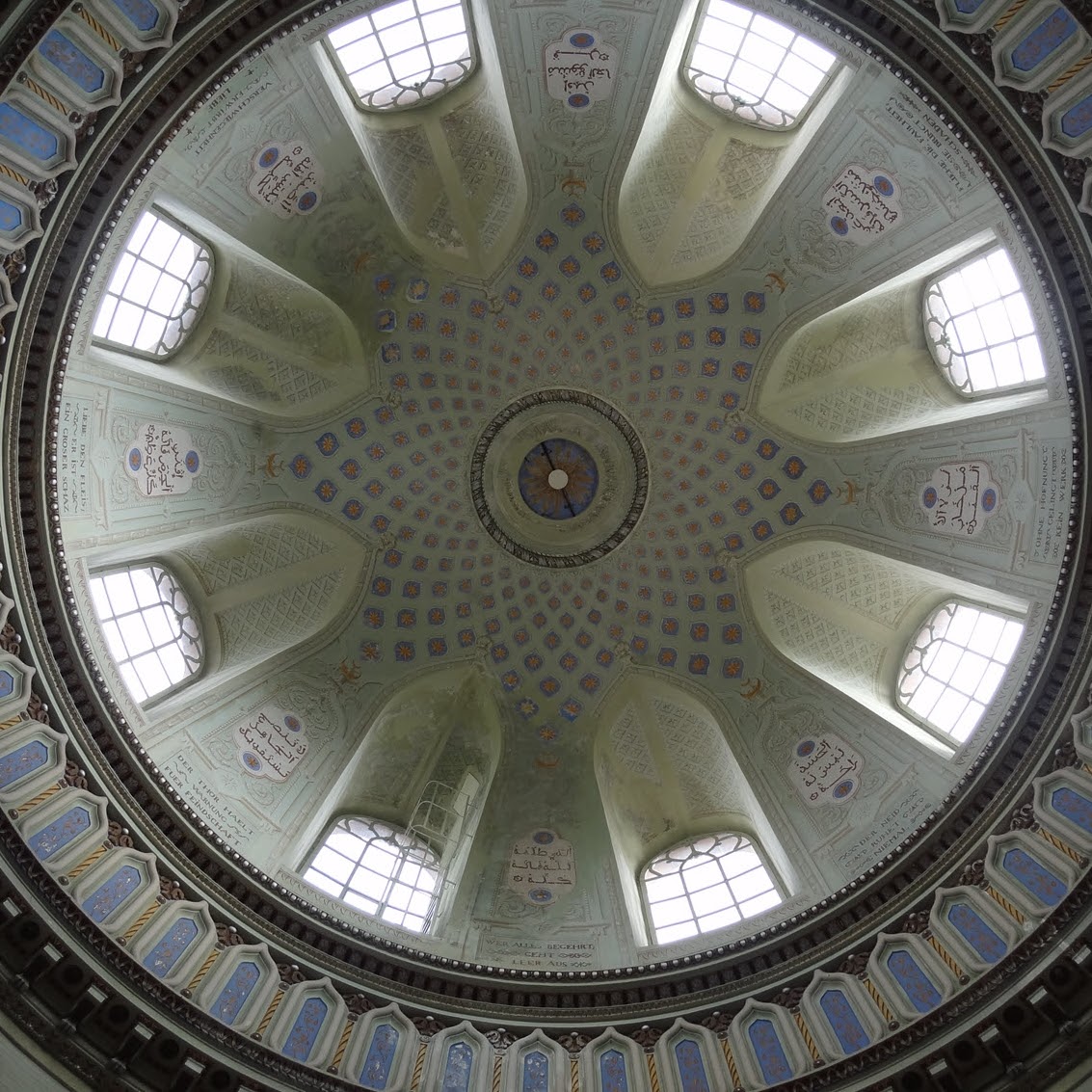
Nicolas de Pigage built the mosque with its central building, the two minarets and prayer courses in 1779. The interior of the mosque consists of a circular central space, which is divided by columns and niches. Inscriptions in Arabic and German language refer to virtues such as wisdom, diligence and discretion. All Arab texts have errors in the dotting of the consonants and the vocalization - a failure of the German mason. It is testimony to the then prevailing interest in the Arab world. It was not built for the purpose of religion but as evidence of tolerance of the enlightened owner Carl Theodor.

Pigage proposed to build the Temple of Mercury in the form of a romantic ruin, as a counterpart to the mosque.Construction began in 1784 - the latest structure in the Schwetzingen palace gardens. Like all other buildings, the Temple of Mercury has multiple meanings: it is a temple, but as a ruin is also reminiscent of a grave, reminding us of the transient nature of life. 


The gardens are dotted with sculptures depicting various themes, from hunting to figures from mythology. Around 86 figures from sandstone, marble or lead have been preserved within the grounds.


The hunting of stags is the theme of the great figures of deer fountain basins in the garden. Artist Peter Anton von Verschaffelt created the powerful figures as a reminder of the origins of the castle. The ones in the garden are only copies though. The originals are kept inside the castle in the Orangerie.


There's a cafe near the entrance but it closes early, so bring plenty of water and some snacks if you plan to stay for a while. Stay off the grass as a general rule and take plenty of breaks on the many benches, even if just to admire the surroundings.

We spent around 3 hours here and hadn't covered even half the grounds.It is easy to lose track of time here.

Danube River God by Peter Anton von Verschaffelt.

Monday, February 24, 2014

Venturing Out

Some people are their own harshest critics. It is one of the reasons I never thought of selling stuff I make - art or food. There are people with much better work out there. But since friends and family have been insisting that it is good enough to sell, I thought why not take a chance. With that I started a Facebook store called Happy Dog Designs of some of my artwork. And if it doesn't work, I can always say "I told you so"!


Wednesday, January 29, 2014

Heidelberg Schloss

The ruin of Heidelberg Castle is the town's most famous landmark and sits beautifully nestled among the hills along the river.

Mark Twain, the American author, described the Heidelberg Castle in his 1880 travel book A Tramp Abroad:
“A ruin must be rightly situated, to be effective. This one could not have been better placed. It stands upon a commanding elevation, it is buried in green woods, there is no level ground about it, but, on the contrary, there are wooded terraces upon terraces, and one looks down through shining leaves into profound chasms and abysses where twilight reigns and the sun cannot intrude. Nature knows how to garnish a ruin to get the best effect. One of these old towers is split down the middle, and one half has tumbled aside. It tumbled in such a way as to establish itself in a picturesque attitude. Then all it lacked was a fitting drapery, and Nature has furnished that; she has robed the rugged mass in flowers and verdure, and made it a charm to the eye. The standing half exposes its arched and cavernous rooms to you, like open, toothless mouths; there, too, the vines and flowers have done their work of grace. The rear portion of the tower has not been neglected, either, but is clothed with a clinging garment of polished ivy which hides the wounds and stains of time. Even the top is not left bare, but is crowned with a flourishing group of trees & shrubs. Misfortune has done for this old tower what it has done for the human character sometimes – improved it."


You could walk up to the castle if you're up for it, but we took the funicular railway which is basically a cable tram that goes up a steep slope. The tram line is relatively new as it was re-built in 1962 (the original was built in 1890). While the lower tram is modern, the upper tram was rebuilt as it was originally designed.

For visiting the castle, you only need tickets for the lower tram. The ticket includes the tram ride and entry to the Palace gardens. For a tour of the palace interiors, you need to buy separate tickets which include a guided tour.


The Castle gardens are well kept and offer a stupendous view of the town below and on a clear day, you can even see the city of Manheim, but like our hosts pointed out, there isn't much to see there!

The castle was built in 1214 and since then has been expanded, re-built, and suffered some destruction (including being hit by lightning twice).


On a visit to Heidelberg in 1838, the French author Victor Hugo took particular pleasure in strolling among the ruins of the castle. He summarised its history in this letter:

“But let me talk of its castle. (This is absolutely essential, and I should actually have begun with it.) What times it has been through! Five hundred years long it has been victim to everything that has shaken Europe, and now it has collapsed under its weight. That is because this Heidelberg Castle, the residence of the counts Palatine, who were answerable only to kings, emperors, and popes, and was of too much significance to bend to their whims, but couldn't raise his head without coming into conflict with them, and that is because, in my opinion, that the Heidelberg Castle has always taken up some position of opposition towards the powerful. Circa 1300, the time of its founding, it starts with a Thebes analogy; in Count Rudolf and Emperor Ludwig, these degenerate brothers, it has its Eteocles and its Polynices [warring sons of Oedipus]. Then the prince elector begins to grow in power. In 1400 the Palatine Ruprecht II, supported by three Rhenish prince electors, deposes Emperor Wenceslaus and usurps his position; 120 years later in 1519, Count Palatine Frederick II was to create the young King Charles I of Spain Emperor Charles V."


The castle gardens is a great way to spend an afternoon just enjoying the view and taking a stroll. It was once even termed as the 8th Wonder of the World, but due to wars and natural disasters, its maintenance was grossly ignored. The tower you see on the way to the garden, the powder turret (where gunpowder was stored), was blown apart by the French in 1793. Another tower that housed prisoners was also destroyed.

The gardens, called Hortus Palatinus, or Garden of the Palatinate was commissioned by Frederick V in 1614 for his wife Elizabeth Stuart. The Elizabeth Gate near the entrance was built the following year (overnight by some accounts) as a birthday present for Elizabeth. Within the compound is a prominent fountain with the statue of Father Rhine (or Neptune, depends on which guide you're reading) symbolizing Germany's river.


Our next stop was the tour of the Castle interiors. As soon as you enter through the Gate Tower, you are faced with a magnificent facade of Friedrich building, which is in a comparatively good condition. The statues that adorn the building are a tribute to the rulers. Within the walls are elaborately decorated rooms that have been recreated to reflect the glory of its times.

The Palace Chapel (Burgkapelle) is also in this building and although not huge, it is very serene.


Just adjacent to it is the Ottheinrich building which at one time were the living quarters and also had a the Emperor's Hall. Just the facade that remains now and it stands hauntingly like a screen door giving glimpses of the blue skies beyond.

The statues on it range of those from the Bible, famous Romans, and some depicting the Christian Virtues. Construction was started by Otto Heinrich during his short reign from 1556 to 1559, and later completed by Fredrick III ten years later.

The ground floor is the only floor that has a ceiling, and this houses the German Apothecary Museum. It gives you a fascinating insight of the evolution of pharmacies. The museum store, among other items has some tin 'medicine' boxes on sale which you can fill with mint (although we didn't like the mint we got from there).


Finally, at the end of the tour, you will come to the famous wine barrels in the cellar. It once held tithe wine (wine that was owed to the ruler by his subjects) and all kinds of wine were mixed into the barrel. At the time, drinking water was mostly contaminated, and wine was the preferred drink as most of the germs were killed during the fermentation process.

The current barrel,constructed in 1750, is the third incarnation and has a capacity of 2,20,000 litres. The original barrel was destroyed during the 30 Years War, and the second one during the War of Palatine Succession. The platform on top of the barrel was made for dancing, and the statue of the court jester, Clemens Perkeo, watches over this treasure.


There is also a bar here for those who get tempted. We decided to go down to the town for our fare.

Friday, December 27, 2013

Reading Challenge - 2013


2013 Reading Challenge

2013 Reading Challenge
Rachna has read 99 books toward her goal of 100 books.
hide

This year I discovered Goodread's Reading Challenge. You set your reading goal for the year and try to achieve it. This came at a great time for me because since I had stopped working last year, I had been planning on catching up on my reading. I have always loved to read but with all of life getting in the way, it had been difficult to make time to read.

I started with a simple goal of 50 books for the year, but within a few days changed it to 100 - it's a challenge after all. Although each book I read has it's review on the site, I wanted to highlight some of them that made me think.

1. A Dog's Tale by Mark Twain - It's only a few pages long but manages to squeeze in so much heartbreak that it was difficult to read the whole thing without pausing and reflecting on it. I would encourage people to have their hearts broken by this story.

2. The Hunger Games series by Suzanne Collins - There was a time when people imagined the future as a Uptopia, but now we think of it as being Dystopian. I loved the concept of war and peace tackled in the book and how history  too often repeats itself. The story is exciting, but it was the underlying thought-provoking dialogues that I loved more.

3. Until Tuesday by  Luis Carlos Montalván - This was such an inspiring story. It's partly about a service dog named Tuesday, which has enough heart-warming power on it's own. The difference I found in this book was the way Luis explains what PTSD (post-traumatic stress disorder) means from the point of view of someone who has to go through it everyday. I have studied psychology in college but never was it so clearly explained as here. 

4. 50 Shades of Grey series by E.L.James - It was my first foray into erotica and is not a great story but I bring it up because the lumpy series takes you completely out of the reality sector and keeps you there till you finish all 3 books. You will want to finish the whole series out of plain curiosity about how the author can drag the story through hundreds of pages (hint: 99% of the pages are a guide and just 1% of it has some semblance of a story line). Leave all commonsense and logic aside when you read it though.

5. And the Mountains Echoed by Khaled Hosseini - Not much happens in the book, but it is not slow or boring by any means. I love the way he understands relationships and drags you into the lives of the people he writes about. Just a good piece of simple writing.

6. Total Recall by Arnold Schwarzenegger - I was never a fan of hard-core action movies but I loved Arnold and Stallone because they didn't put all their eggs in the action basket. It is inspiring how he pushed himself to be better when he could have taken it easy - it fills you with optimism because he puts his personality in the pages. He does talk about his mistakes and doesn't just glaze over it. A complete look into his life till now.

7. Of Mice and Men by John Steinbeck - The book is beautifully written and makes you feel every emotion as it were happening right in front of your eyes. I didn't read up on the background in which the story is set till after I read it (in one sitting because I couldn't put it down) and it was close to what I had gathered from my reading - so expertly it has been presented.

8. Behind the Beautiful Forevers by Katherine Boo - It reads like fiction but it is not. The stories of a handful of people from the slums is brought alive. It is often easy to dismiss people you see begging on the streets as someone who doesn't want to work, but when you look into the environs they've been forced to live in, you wonder what makes them smile so joyously sometimes.

9. Jane Eyre by Charlotte Brontë - Having read books like Twilight and 50 Shades, and hearing of current books that depict girls and women as self-pitying creatures only interested in bagging a boy, this age-old book was such a fresh breath of air. The dialogues of a woman secure in her independence and self-worth fill you with pride: 
“I am not an angel,' I asserted; 'and I will not be one till I die: I will be myself. Mr. Rochester, you must neither expect nor exact anything celestial of me - for you will not get it, any more than I shall get it of you: which I do not at all anticipate.”
9a. Pride and Prejudice by Jane Austen - I re-read this classic and was blown over by it again. It is a book that gives you something different each time you read it in different stages of your life. The first time I read it, I looked at it as a love story. This time I saw how the strong-willed Elizabeth stood out in comparison to her sisters and friends. I classify it in the same bracket as Jane Eyre in terms of girl-power.

10. Unbearable Lightness: A Story of Loss and Gain by Portia de Rossi - I was never able to understand how anorexic women don't realize that being skeletal is unattractive or that if they don't eat something, they will die. Portia explains it in this book. No matter what kind of support system you have in your life, sometimes it is just not enough. One can only hope that self-realization comes before it is too late.

11. The Fault in our Stars by John Green - It is a typical book for teenagers, with young humour and romance. The only difference is that the protagonists have cancer and they look for ways to make the most out of life while they can. What really got to me though was the story within the story: an author writes a book from the point of view of a terminally ill girl and ends it mid-sentence. Powerfull stuff!

12. The Elephant Whisperer by Lawrence Anthony - Elephants are such perceptive creatures and have strong family ties. The instances from their behaviour Lawrence relates are so relatable as human traits that you stop to wonder why they are inside fences.

13. The Reason I Jump by Naoki Higashida - There have been many books on autistic children by parents and care-givers but this is one of the first by the child himself. He debunks many myths surrounding autism - they're not immune to feelings and don't want to be isolated. An important book to read to have a clearer understanding of people around you.

14. I am Malala by Malala Yousafzai - I was impressed by how this young girl from a small rural town spoke even with International audiences. She exudes confidence. She talks of her village and the troubles that plague it, but unfortunately instead of promoting her stand on education for all, her countrymen have criticized and attacked her for airing their dirty laundry in public. I was also touched by the support she has received from her father even in the face of threats. Even if you don't read her book, hear her speak.

15. The Reluctant Fundamentalist by Mohsin Hamid - I like the way the book is presented as a monologue, and how he points out the discomfort of his companion with naivete. I especially liked how ambiguously he ended the narrative.

16. An Astronaut's Guide to Life on Earth by Chris Hadfield - His life is a classic example of picturing your goal and working backwards from there to achieve it. His life lessons and descriptions of what life is like as an astronaut are a pleasure to read, mixed with enough light-heartedness and anecdotes.

Biographies of Prominent Indians
Although every story in this section was inspiring to the core, and of Indians who have excelled in their fields, the books were written and edited in a way that put a dampener on my experience. The sequence of events are presented in a very matter-of-fact way and doesn't make you empathise or feel (unless you try very hard). Indian editors should encourage the concept of ghost-writing and making the story relatable, otherwise how is it better than a Wikipedia article?

17. The Race of My Life by Milkha Singh - I was very excited that he was sharing his story. I have always heard of his achievements as one of India's greatest athlete (and only prominent runner) but how he got to that point is an even better story although one filled with sadness and hardships.

18. The Victoria Cross by Ashali Varma - Written by the daughter, it is the story of the first Indian to be awarded the Victoria Cross, and his wife. I had picked this book up from a random selection without knowing about Lt. Prem Bhagat - a great military man and manager.

19. UnBreakable by M.C. Mary Kom - Coming from a region largely ignored my the mainland, she has achieved much and is an inspiration to young girls who are boxed into 'girlie' life-roles. One of the few sportswomen who has been able to achieve greatness on an international playing field solely on her dedication and hard work (and the amazing support of her husband), even after giving birth to three children.

20. Wings of Fire by A.P.J. Abdul Kalam - You would assume a scientist would be an atheist and not be impressed with poetry, preferring reality and straight-forwardness. But Kalam is in a different league. He quotes and writes beautiful poems, quotes religious texts and is very spiritual. As outsiders to someone whose life is focused on a single goal, we feel like they are missing out on the rest of the world. But he reminds us that if he is getting his happiness and contentment from the work he is doing, then who are we to judge.

Friday, December 20, 2013

Cake Box

Recently I had to take a home-baked cake to someone's home and hadn't yet invested in a cake carrier.

I have previously resorted to making cupcakes or brownies instead, but I wanted to try making a cake box - it couldn't be more difficult than making the actual cake, could it? It wasn't.

I found a helpful guide on how to go about making a box instead of just winging it (Crystal's Creative Creations). Tip: It makes life a lot simpler if you use a cutter to score the card before folding it. I tried folding the first line without it and it didn't some out clean.

The only changes I made was to go with a fully-covered top with some drawings instead of the clear film, and since the card paper I got wasn't very thick, I trimmed the cardboard base covering the whole base instead of circular.

I drew over the top sheet after marking the folds, but before sticking them into place, and I lined the cardboard base with aluminium foil - some fancy foil would have looked looked but I didn't have any.

The box and cake were highly appreciated. Recipe for cake.


Friday, November 29, 2013

Ganesh on the Wall

My sister-in-law wanted a Ganesh painting for her wall. Instead of painting one big Ganesh I decided on doing a set of four. One reason being it was hard for me to choose just one design out of the million; second reason being it is just very difficult for me to manage one big painting because I lose patience fast; and lastly, it's easier to carry on flight.

I had just a week to finish them so I did some preliminary sketches and went to the hobby store, stacked up on acrylic paints and rushed home - only to find that the gold and silver bottles I picked up were powdered pigments and I needed a medium. But they didn't have any at the store! The Internet didn't give me any helpful alternatives either. Since we were travelling to meet some people on the other side of town, I checked their other branch if they had any - thankfully they did.

I had to use 2-3 coats of colour to get some consistency in the paintings. They seemed very diluted on their own. 

For the silver Ganesh, I wanted to use the silver powder to highlight the edges but the wind blew and scattered the pigment a little. It seemed to work so that's what I did on purpose - just dabbed a little powder on the edges then blew lightly in the direction I wanted the powder to scatter. It would be better to do this in parts to avoid a mess.

My metallic pens from my previous projects came in very handy to discreetly outline the edges of the drawings after the colours had been filled in. I thought about doing some detailed Zentangles over the images but then opted to keep it clean and simple. 


Tuesday, November 12, 2013

Drawings

I have fallen behind on my little Zentangle notebook that I tried to scribble in everyday, mainly because I've been travelling, and also because I was working on a bigger scale. These are some of the sets I made last month.

The first one took me over a day for each letter (10x10 inches each). I had to pencil in the dimensions for the borders and letters for uniformity, otherwise I prefer freehand. The next step was to watercolour it. I have to admit that I was disappointed with the way it looked with just the watercolours and I thought I have wasted a whole lot of time for nothing. But when I outlines it with my micron pens, it started to really stand out. Phew!

The animal set just started out as a trial with the peacock, but I liked the owl I saw somewhere so that came next. But just two seemed incomplete, so I found a curious giraffe. I made this on thick printing paper so the pens were gliding on them as opposed to the watercolour paper I used for the previous one.

The other two pieces were also experiments. I had some good art paper but were too dark for the micron pens. Even the metallic ones I got didn't stand out too well. So I used watercolour to lighten the background, then used the pens for the design. These are all freehand therefor not too straight at the borders.

Love for All Seasons (watercolour on paper, with coloured pencils and pens)

Animal Kingdom (Coloured pencils on paper)

Joy & Freedom (Watercolours and metallic markers on paper)

Floating in Space (watercolour and metallic markers on paper)